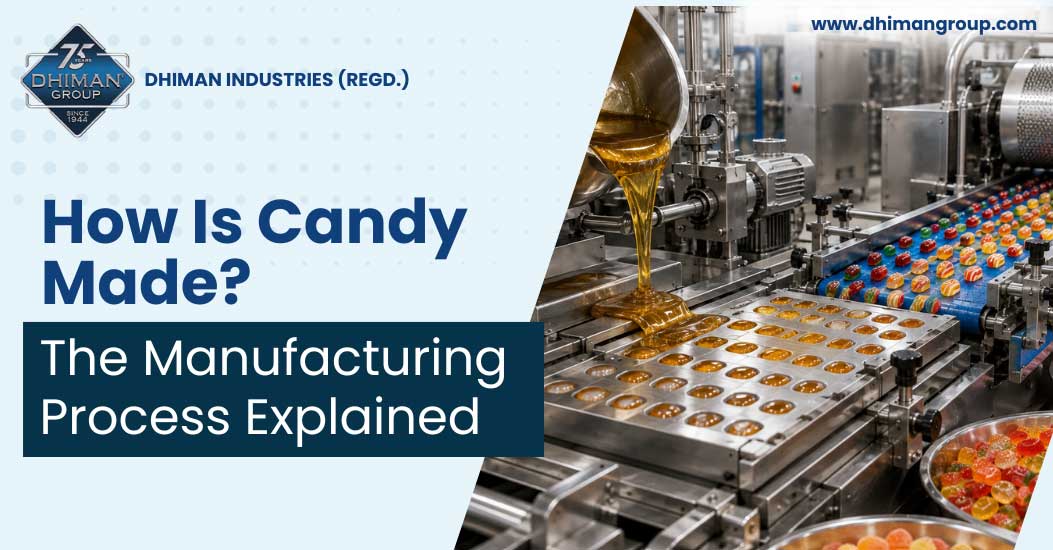
Creating sweets requires precision and immense dedication to the craft. At Dhiman Industries, we understand the delicate balance of heat and timing.
Our engineers have refined these intricate processes continuously since 1944. Reliable candy manufacturing equipment ensures perfect textures and consistent flavours every single time.
Many people wonder how simple raw sugar transforms into delightful treats. We will explore the fascinating journey from raw syrup to the final product together.
The Importance of Sugar Boiling
Boiling sugar is the critical first step in confectionery production. The exact temperature determines the final texture of the sweet.
Furthermore, a high-quality candy cooker dissolves the raw ingredients efficiently. We rely on advanced boiling systems to prevent crystallisation and burning.
Such precision allows us to create both soft chews and hard sweets. Let us review the primary boiling methods we employ.
- Batch Systems: These units cook smaller separate quantities of sugar syrup for specialty items.
- Vacuum Systems: Removing air creates a highly transparent and remarkably stable mixture.
Shaping The Sweet Delights
Once the syrup reaches the correct temperature, it requires immediate shaping. The molten hot mixture moves to the forming section swiftly.
Consequently, operators must handle the hot mass carefully to maintain its pliability. Dhiman Industries focuses on maintaining optimal temperatures during this transfer phase.
Moreover, different shapes require varied mechanical approaches for optimal results. Let us examine three distinct shaping techniques we utilise in our advanced facilities.
- Rotary Forming: High-speed dies punch out solid shapes from the continuous sugar rope efficiently.
- Chain Forming: Continuous chains mould the sugar centre for filled sweets accurately and swiftly.
- Drop Forming: A specialised candy drop roller presses the warm sheet into uniform seamless pieces.
Using a robust candy making machine, we process the hot mass efficiently. The mixture passes through specific rollers to achieve the desired thickness.
Operators monitor the sugar rope carefully to ensure consistent width. Any variation in the rope size will affect the final product weight negatively.
Cooling and Conditioning Techniques
Freshly formed sweets are extremely hot and prone to deformation. Therefore, proper cooling ensures they retain their shape and avoid sticking together.
The products travel along extensive cooling tunnels with controlled airflow. Maintaining the correct ambient humidity prevents the sugar from absorbing moisture.
A reliable candy forming machine works seamlessly with these cooling belts. Dhiman Industries integrates these systems to ensure a smooth transition.
We monitor the cooling duration strictly for every specific recipe. Rapid cooling environments might cause the delicate sweets to crack prematurely.
Gradual temperature reduction yields a shiny and highly stable final product.
Wrapping and Final Packaging
Effective packaging protects the sweets from environmental factors and external contamination. Proper wrapping also extends the shelf life of the confectionery significantly.
Our packaging lines operate with remarkable speed and strict precision. Sweets move into individual wrappers before going into larger distribution bags.
We utilise various wrapping styles depending on the market requirements. Additionally, the chosen material must provide an effective barrier against humidity.
- Twist Wrapping: Packaging film twists around the sweet tightly on both opposing ends.
- Pillow Packing: The machine seals the product flat inside a rectangular film pouch.
- Fold Wrapping: Premium paper folds neatly around the square or rectangular confectionery shapes.
- Stick Packing: Multiple sweets align securely in a row within a single tubular wrapper.
Quality control sensors reject any improperly sealed packages automatically. Dhiman Industries proudly ensures only perfect confectionery items reach the consumers.
What Makes Candy Production Efficient?
Efficiency does not come from one machine alone. It comes from matching every stage so that one process does not slow down another.
Manufacturers should consider these practical factors:
- Recipe control: Maintain accurate ingredient ratios and repeatable cooking conditions.
- Machine selection: Match equipment capacity with required output and product type.
- Process flow: Connect cooking, forming, cooling, and packing with minimal handling.
- Maintenance support: Plan servicing and technical assistance to keep equipment dependable.
Dhiman Industries has operated in confectionery machinery since 1944, with expertise across kitchen, forming, packing, and complete confectionery systems. We also provide custom design, manufacturing, installation, and support.
Conclusion
Manufacturing confectionery is a meticulous blend of culinary art and engineering. Dhiman Industries proudly remains committed to advancing these manufacturing techniques globally.
Operating since 1944 has taught us the profound value of process refinement. We consistently deliver reliable machinery that meets modern production demands flawlessly.
Understanding the journey from syrup to sweet reveals the underlying complexity. We sincerely hope you found our detailed manufacturing insights genuinely informative.
Quality equipment truly shapes the joy found in every single sweet.
Frequently Asked Questions
How can I increase candy production efficiency?
To increase the candy production efficiency, you should automate manual transfer steps between cooking and forming stages. Upgrading to continuous processing lines reduces downtime and increases overall output significantly.
What is the difference between a batch cooker and vacuum cooker?
A batch unit cooks smaller and separate quantities of sugar syrup slowly at a time. A vacuum unit removes air and moisture to cook faster at lower temperatures. The suitable option depends on your product and production needs.
Why do boiled sweets sometimes become sticky?
Boiled sweets can become sticky when they absorb moisture from the surrounding air. High humidity, insufficient cooking, or improper cooling can increase surface moisture. Poor packaging can also allow moisture to enter after production.
How long does confectionery machinery typically last?
Confectionery machinery can remain operational for many years when manufacturers maintain it properly. Its lifespan depends on machine quality, operating conditions, production volume, cleaning, servicing, and timely replacement of worn components.
 sales@dhimangroup.com
  +91 98140 88415
  +91 9814088415
  Dhiman Industries: Dakhni Gate, Nakodar 144 040