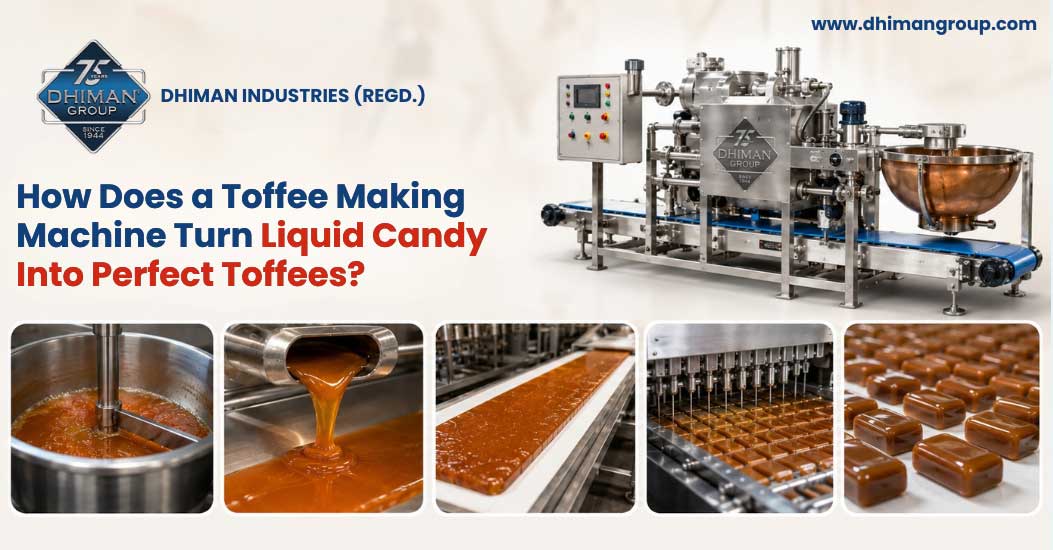
Transforming boiling liquid syrup into perfectly chewy sweets requires an exact balance of rapid cooling and immense mechanical pressure. A highly calibrated toffee making machine orchestrates the entire manufacturing sequence seamlessly. Heat extracts the moisture, while heavy duty rollers knead the pliable mass into precise geometrical shapes.
At Dhiman Industries, our expert engineers have perfected the intricate science behind modern commercial confectionery manufacturing operations. Operating successfully since 1944, we design robust equipment that consistently delivers perfectly textured sweets for leading global brands.
The Initial Stages Of Syrup Preparation
Naturally, the confectionery production cycle always begins inside heavy industrial cooking vessels. Sugar, glucose, and fats blend at precise thermal levels to create a homogeneous syrup base. Our advanced equipment ensures the mixture reaches the exact required consistency without burning or crystallising prematurely.
- Continuous Agitation: Heavy duty scraping arms stir the thick liquid constantly to maintain proper ingredient distribution.
- Regulated Cooling: The boiling syrup glides over chilled metal surfaces to lower its core temperature gradually.
- Texture Preservation: Gradual cooling ensures the hot mass reaches a highly pliable state for the batch roller.
Batch Rolling And Rope Sizing Processes
Subsequently, the pliable candy mass enters the batch roller to become a uniform thick cone. Sizing rollers then pull that sugar cone into a continuous narrow rope of candy. As prominent toffee machine manufacturers in India, we engineer our metallic rollers for zero product slippage.
Conical rollers gently spin the large candy mass into an elongated cone shape effectively. Reducing wheels then draw the candy out to the exact final diameter accurately. Such continuous sizing prepares the rope for the high speed cutting dies seamlessly.
Shaping And Forming The Final Product
Ultimately, the precisely sized sugar rope finally enters the main forming section directly. High speed rotary dies cut and press the continuous rope into individual bite sized pieces. Top toffee making machine suppliers understand that exact die alignment prevents costly material wastage completely.
- Precision Cutting: Sharp mechanisms sever the thick rope seamlessly without distorting the final cylindrical shape.
- Die Pressing: Mechanical plungers instantly shape the cut sections into distinct, consistent, and beautiful geometries.
Specialised Equipment For Chewy Varieties
Alternatively, certain complex recipes demand a slightly different mechanical approach altogether during production. A dedicated chew toffee machine processes highly aerated or exceptionally soft mixtures effortlessly. Such specific engineering units apply gentle pressure to maintain the delicate structural integrity of the sweets.
- Aeration Handling: Advanced mechanical systems accommodate entrapped air carefully to prevent the product from collapsing under intense manufacturing stress.
Careful product handling guarantees that the soft texture remains perfectly intact throughout the entire factory journey. Operators can easily adjust the modern wrapping parameters to match the specific physical dimensions of any new candy line.
Wrapping And Final Packaging Stages
Finally, the formed pieces must cool completely before reaching the automated wrapping station. Our advanced cut and wrap systems enclose each sweet in protective film at incredible speeds. Reliable toffee machines exporters always prioritise robust packaging mechanisms for safe global distribution.
Conclusion
Manufacturing excellent commercial confectionery requires perfect harmony between heat control and intense mechanical precision. The complex journey from a boiling liquid to a perfectly formed sweet relies heavily on robust engineering. Dhiman Industries remains fully committed to building equipment that delivers consistent results daily.
We have proudly supported leading global confectionery brands for eight successful decades now. Manufacturers can always rely on our advanced engineering to elevate their daily factory output significantly. Our expert technical team is always available to discuss your specific facility requirements in detail.
Frequently Asked Questions
What machines are required for eclair production?
Eclair production requires a specialised centre-filling machine integrated seamlessly with a continuous batch forming line. A dedicated cooker prepares the caramel casing while an independent pump injects the liquid chocolate centre. Such mechanically coordinated systems ensure perfect filling distribution across the entire production batch.
How do you prevent sticky candy from jamming the machinery?
Our heavy machinery utilises temperature controlled environments and specially coated contact surfaces thoroughly. Regulated ambient cooling ensures the candy mass hardens appropriately before it enters the high speed cutting blades. Operators therefore rarely face unexpected machine stoppages during their standard daily manufacturing shifts.
Can one production line handle multiple sweet sizes?
Yes, our advanced forming machines feature interchangeable die sets for maximum daily manufacturing flexibility. Operators can quickly switch out the cutting heads to produce different shapes on the exact same line. Such mechanical adaptability effectively maximises your overall financial return on equipment investment.
What maintenance schedule does the forming equipment require?
Operators should perform daily cleaning of all product contact parts to ensure absolute factory hygiene. Mechanical components require weekly lubrication and routine monthly inspections to maintain peak operational efficiency constantly. Proper routine upkeep directly extends the overall operational lifespan of the forming machinery significantly.
 sales@dhimangroup.com
  +91 98140 88415
  +91 9814088415
  Dhiman Industries: Dakhni Gate, Nakodar 144 040